
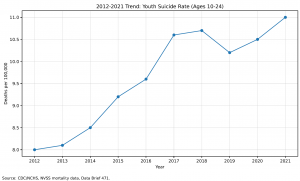
Just over the past ten years data shows an alarming and unprecedented increase in youth suicide. Your financial support of the Wesleyan Foundation For Men (WFFM) can actually serve to address important root causation and provide preventive measures to reverse this trend!
WFFM Grants go to groups and organizations with action plans to serve Fathers and Youth to transform negative environments and improve families. This in turn directly addresses many of the factors that lead to this dramatic increase in youth suicide. Teaching men how to become loving, engaged and supportive fathers changes the outcome trajectory of children in positive ways. Likewise having father actively engaged with the family helps to establish healthy self-image of youth.
Factors related to the increase of youth suicide include the following:
Family Structure & Stability
Research consistently shows higher suicide risk among youth who experience:
- Parental absence (especially father absence)
- Divorce or family fragmentation
- Living in single-parent or unstable households
📊 Findings:
- Youth in single-parent households are significantly more likely to report depression and suicidal ideation.
- A study in JAMA Pediatrics found that adverse childhood experiences (ACEs)—including family instability—are strongly associated with suicide attempts.

Struggling Youth
Parent-Child Relationship Quality
More important than structure alone is relationship quality:
- Low parental involvement
- Lack of emotional support
- Poor communication
📊 CDC Youth Risk Behavior Survey (YRBS):
- Youth who report strong parental connection are far less likely to attempt suicide.
- Feeling “connected” to at least one adult is a major protective factor.
C. Abuse, Neglect, and Trauma
- Physical, emotional, or sexual abuse dramatically increases suicide risk.
- Children with multiple ACEs are several times more likely to attempt suicide.
Identity Struggles and Social Pressures
A. Identity Confusion and Internal Conflict
Adolescence is a critical period for identity formation:
- Questions around self-worth, purpose, belonging, and identity
- When unresolved, these can lead to isolation and despair
B. Sexual Identity and Gender Identity Stress
- LGBTQ+ youth report significantly higher rates of suicidal ideation and attempts
- Key drivers include:
- Rejection by family
- Bullying and social exclusion
- Internal conflict and stigma
📊 The Trevor Project (2023):
- Over 40% of LGBTQ youth seriously considered attempting suicide
- Those with supportive family environments had dramatically lower risk
👉 Key takeaway:
Family acceptance is one of the strongest protective factors, even in high-risk identity groups.