In response to a new opportunity to equip men in Africa the General Commission on United Methodist Men applied for a grant to send a team to Zimbabwe. The purpose was to provide a framework resources to support a local ongoing ministry to equip men to become good husbands, fathers and civic servants.
Hosted by Africa University the inaugural gathering Dec. 9-11 at United Methodist-related Africa University brought together about 30 men from each of the denomination’s four African regional conferences to discuss issues affecting them and work to grow men’s ministry on the continent.
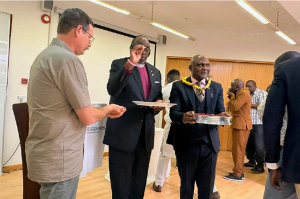
GCUMM Leaders with Bishop Nelson Kalombo Ngoy
“The main idea was to listen, empower and equip the United Methodist men on the continent of Africa because if men in Africa are transformed, the entire world will be transformed. Indeed, the idea was to encourage men to understand the significance of their calling and role as disciples of Jesus Christ within the body of Christ, so that they can be useful to advance the kingdom and to respond to the Christian mandate and mission to make disciples of Jesus Christ for the transformation of the world,” Ngoy said.
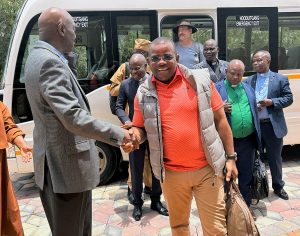
The Rev. Antonio Macilau Vilanculo of Mozambique said he learned that men’s problems are the same in many countries. It was his first time interacting with colleagues from across the continent.
Among the concerns expressed by attendees were marginalization in church activities, trauma from war in countries such as Congo, Sudan and South Sudan, and an inability to open up due to socialization and the belief that showing emotions is a sign of weakness.
“I bring with me the reality that as Methodist men, we are already shirking our responsibility to be the head of our families and communities. This is now the time for us to organize ourselves and begin men’s activities,” he said.
James H. Salley, Africa University president and chief executive officer of Africa University Tennessee Inc. and associate vice chancellor for institutional advancement, said the gathering gave men the opportunity to learn from other conferences.
“We learned that men need to talk more across conferences; the more they talk the better we can carry out the mission of the church,” said Salley, who is a lay member of the South Carolina Conference.
“It’s good to have men who graduated from AU back on campus in leadership across the continent. We thank them, especially Bishop Ngoy.”
Salley told UM News that his home South Carolina Conference probably has the largest regular gatherings of United Methodist men, with one event attracting over 1,100.
“I’ve heard gatherings of The UMC are for women,” he said. “It’s the first time that men have been invited to talk about how to get them involved in church. It’s something they have been looking for a long time, an opportunity to talk to other men and hear what’s happening in their episcopal areas.”
Salley urged the Zimbabwe men who are locally called “vabvuwi” (fishers of men) to give lessons to their counterparts to help develop their ministries.
Vabvuwi have a variety of programs, including medical outreach where they provide free medical consultation and treatment, spiritual conventions and income-generating projects. The men have purchased vehicles and founded two schools: Nyadire Secondary in Zimbabwe West in 1977 and Clare Secondary in Zimbabwe East in 2005.
“This is the start of a new movement, better late than never. The excitement and enthusiasm of these men may surpass U.S. standards,” Salley said.